
1. Introduction to Crow’s Foot Notation
Crow’s Foot Notation is a graphical representation used in Entity-Relationship Diagrams (ERD) to illustrate relationships between entities in a relational database. This notation uses symbols to describe the cardinality (one-to-one, one-to-many, many-to-many) and participation (mandatory or optional) of entities in a database.
2. Crow’s Foot Symbols
Crow’s Foot Notation uses different visual indicators for relationships:
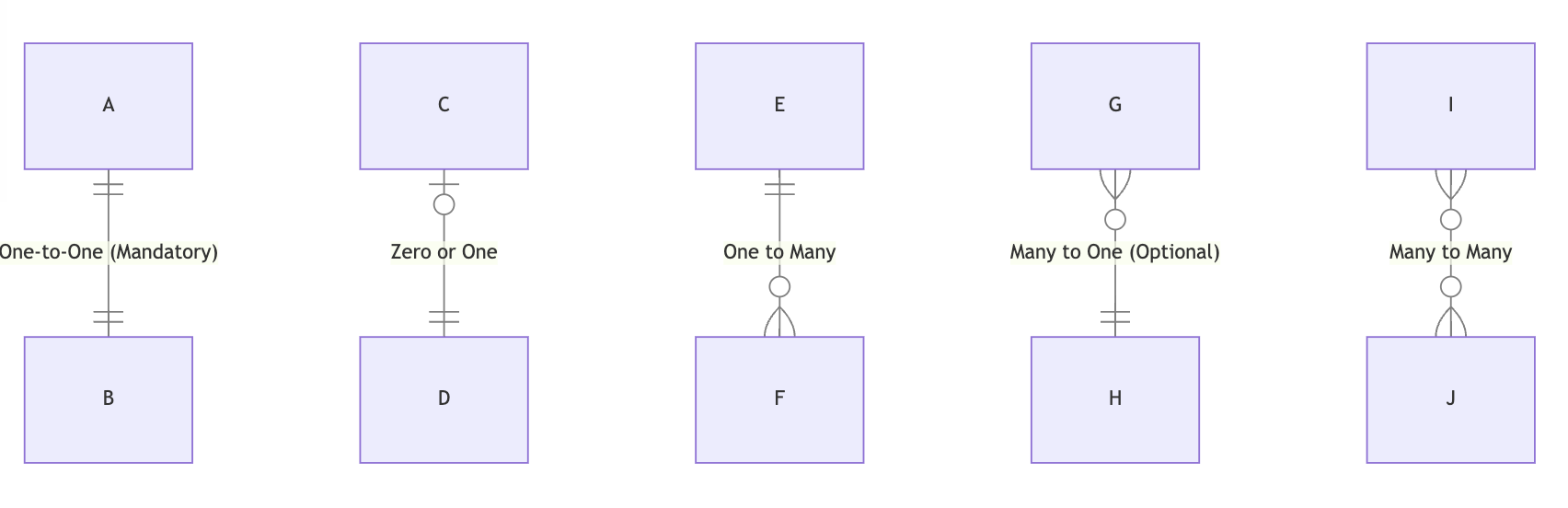
| Symbol | Meaning |
|---|---|
| Two lines | One (mandatory). Each instance must be in a relationship once |
| Line and circle | Zero or One (optional). Each instance can be related to zero or one entities |
| CrowFeet | MANY. Each element related zero, one or many |
Mermaid Example: Crow’s Foot Symbols
erDiagram
    A ||--|| B : "One-to-One (Mandatory)"
    C |O--|| D : "Zero or One"
    E ||--o{ F : "One to Many"
    G O{--|| H : "Many to One (Optional)"
    I O{--o{ J : "Many to Many"
3. Relationship Types with Crow’s Foot Notation
Here are the different relationship types with examples.
3.1 One-to-One (1:1) Relationship
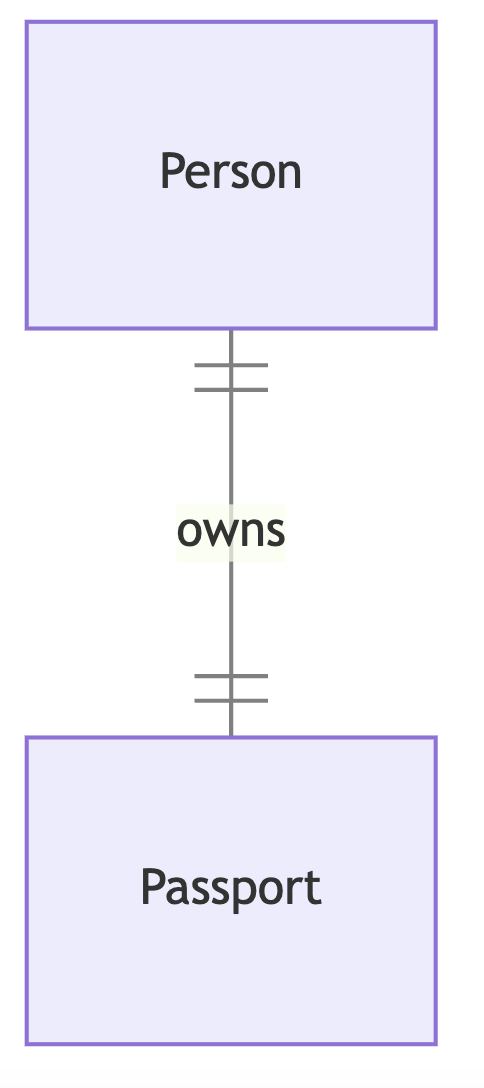
Each entity is related to only one entity in the other table.
Example: Each Person has one Passport, and each Passport is assigned to one Person.
erDiagram
    Person ||--|| Passport : "owns"
3.2 One-to-Many (1:N) Relationship
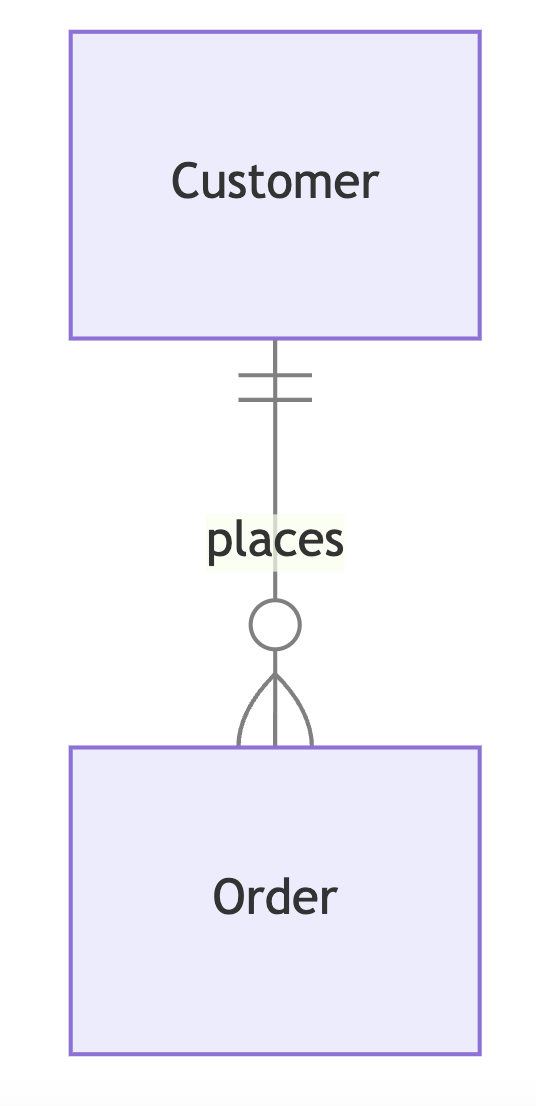
One entity is related to many entities in the other table.
Example: A Customer can place many Orders, but each Order belongs to only one Customer.
erDiagram
    Customer ||--o{ Order : "places"
3.3 Many-to-Many (M:N) Relationship
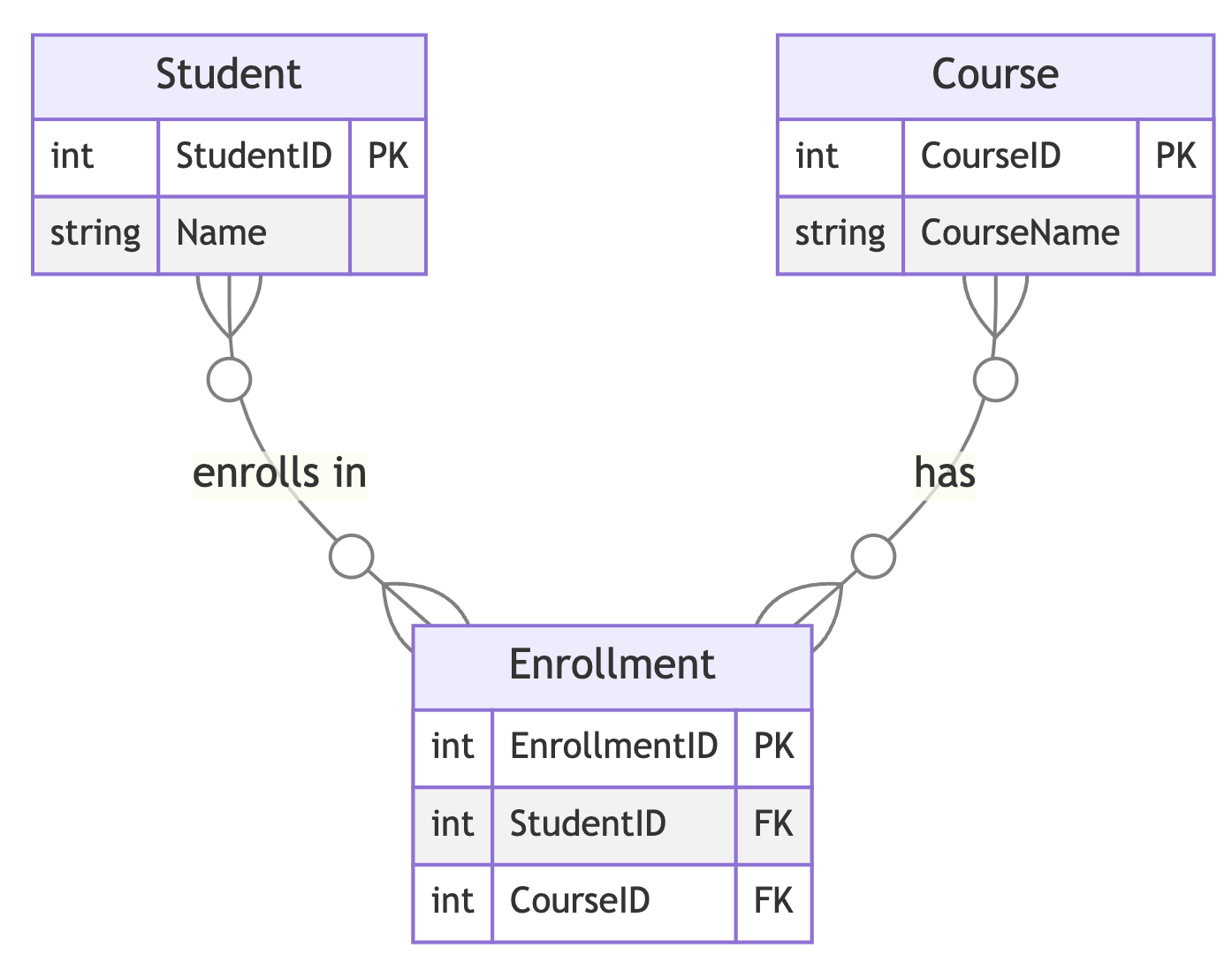
Each entity can be associated with many records in the other table. This requires an intermediate table (junction table).
Example: A Student can enroll in many Courses, and a Course can have many Students.
erDiagram
    Student {
        int StudentID PK
        string Name
    }

    Course {
        int CourseID PK
        string CourseName
    }

    Enrollment {
        int EnrollmentID PK
        int StudentID FK
        int CourseID FK
    }

    Student o{--o{ Enrollment : "enrolls in"
    Course o{--o{ Enrollment : "has"
4. Mandatory vs. Optional Relationships
Participation constraints define whether an entity is required to have a related entity.
4.1 Mandatory Relationships
An entity must participate in the relationship.
Example: Every Order must have an associated Customer.
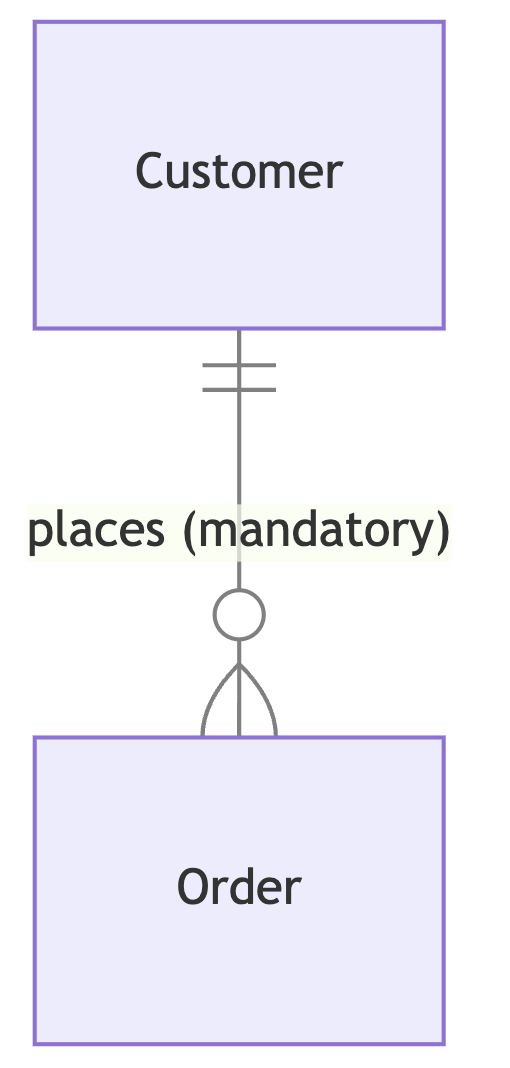
erDiagram
    Customer ||--o{ Order : "places (mandatory)"
4.2 Optional Relationships
An entity may or may not participate in the relationship.
Example: A Customer may place Orders, but they might not have placed any yet.
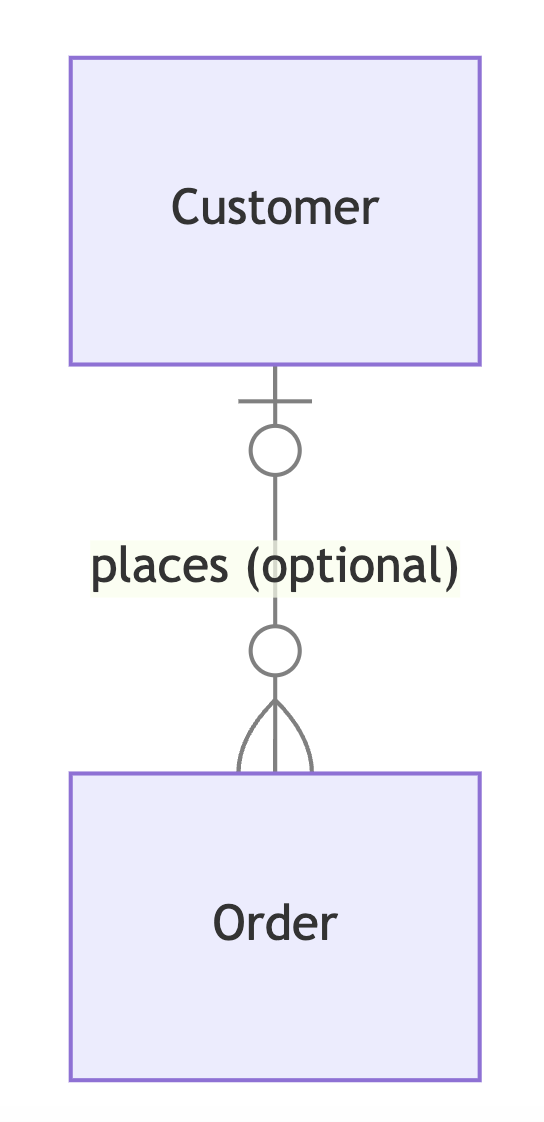
erDiagram
    Customer |O--o{ Order : "places (optional)"
5. Conclusion
Crow’s Foot Notation is a powerful way to visualize relationships in database design. Mermaid provides an easy-to-use syntax for creating ER diagrams that clearly illustrate cardinality and participation constraints.