
Merge sort is a sorting algorithm that works by dividing an array into smaller subarrays, sorting each subarray, and then merging the sorted subarrays back together to form the final sorted array.
In simple terms, we can say that the process of merge sort is to divide the array into two halves, sort each half, and then merge the sorted halves back together. This process is repeated until the entire array is sorted.
One thing that you might wonder is what is the specialty of this algorithm. We already have a number of sorting algorithms then why do we need this algorithm? One of the main advantages of merge sort is that it has a time complexity of O(n log n), which means it can sort large arrays relatively quickly. It is also a stable sort, which means that the order of elements with equal values is preserved during the sort.
Merge sort is a popular choice for sorting large datasets because it is relatively efficient and easy to implement. It is often used in conjunction with other algorithms, such as quicksort, to improve the overall performance of a sorting routine.
Merge Sort Working Process:
Think of it as a recursive algorithm continuously splits the array in half until it cannot be further divided. This means that if the array becomes empty or has only one element left, the dividing will stop, i.e. it is the base case to stop the recursion. If the array has multiple elements, split the array into halves and recursively invoke the merge sort on each of the halves. Finally, when both halves are sorted, the merge operation is applied. Merge operation is the process of taking two smaller sorted arrays and combining them to eventually make a larger one.
Illustration:
To know the functioning of merge sort, lets consider an array arr[] = {38, 27, 43, 3, 9, 82, 10}
- At first, check if the left index of array is less than the right index, if yes then calculate its mid point
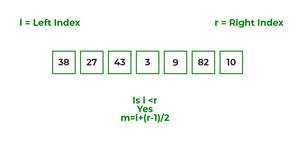
- Now, as we already know that merge sort first divides the whole array iteratively into equal halves, unless the atomic values are achieved.
- Here, we see that an array of 7 items is divided into two arrays of size 4 and 3 respectively.
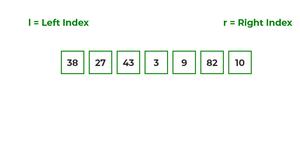
- Now, again find that is left index is less than the right index for both arrays, if found yes, then again calculate mid points for both the arrays.
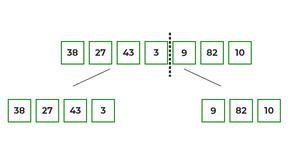
- Now, further divide these two arrays into further halves, until the atomic units of the array is reached and further division is not possible.
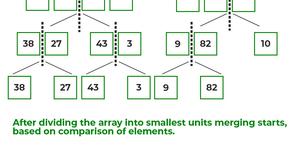
- After dividing the array into smallest units, start merging the elements again based on comparison of size of elements
- Firstly, compare the element for each list and then combine them into another list in a sorted manner.
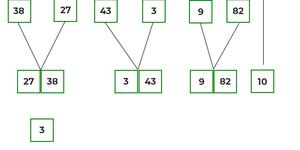
- After the final merging, the list looks like this:
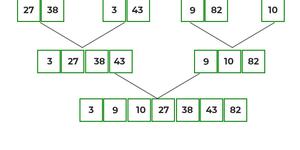
The following diagram shows the complete merge sort process for an example array {38, 27, 43, 3, 9, 82, 10}.
If we take a closer look at the diagram, we can see that the array is recursively divided into two halves till the size becomes 1. Once the size becomes 1, the merge processes come into action and start merging arrays back till the complete array is merged.
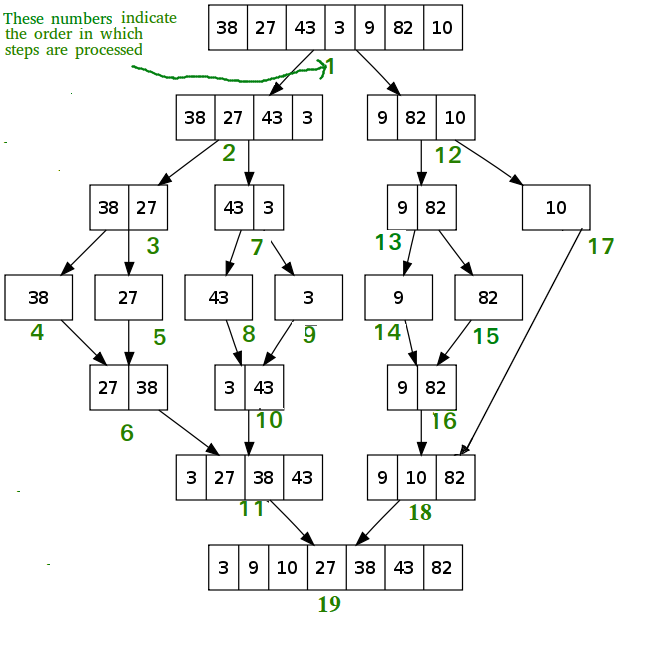
Recursive steps of merge sort
Algorithm:
step 1: start
step 2: declare array and left, right, mid variable
step 3: perform merge function.
if left > right
return
mid= (left+right)/2
mergesort(array, left, mid)
mergesort(array, mid+1, right)
merge(array, left, mid, right)step 4: Stop
Follow the steps below to solve the problem:
MergeSort(arr[], l, r)
If r > l
- Find the middle point to divide the array into two halves:
- middle m = l + (r – l)/2
- Call mergeSort for first half:
- Call mergeSort(arr, l, m)
- Call mergeSort for second half:
- Call mergeSort(arr, m + 1, r)
- Merge the two halves sorted in steps 2 and 3:
- Call merge(arr, l, m, r)
- Call merge(arr, l, m, r)
Time Complexity: O(N log(N)), Sorting arrays on different machines. Merge Sort is a recursive algorithm and time complexity can be expressed as following recurrence relation.
T(n) = 2T(n/2) + θ(n)
The above recurrence can be solved either using the Recurrence Tree method or the Master method. It falls in case II of the Master Method and the solution of the recurrence is θ(Nlog(N)). The time complexity of Merge Sort isθ(Nlog(N)) in all 3 cases (worst, average, and best) as merge sort always divides the array into two halves and takes linear time to merge two halves.
Auxiliary Space: O(n), In merge sort all elements are copied into an auxiliary array. So N auxiliary space is required for merge sort.
Is Merge sort In Place?
No, In merge sort the merging step requires extra space to store the elements.
Is Merge sort Stable?
Yes, merge sort is stable.
How can we make Merge sort more efficient?
Merge sort can be made more efficient by replacing recursive calls with Insertion sort for smaller array sizes, where the size of the remaining array is less or equal to 43 as the number of operations required to sort an array of max size 43 will be less in Insertion sort as compared to the number of operations required in Merge sort.
Analysis of Merge Sort:
A merge sort consists of several passes over the input. The first pass merges segments of size 1, the second merges segments of size 2, and the  pass merges segments of size 2i-1. Thus, the total number of passes is [log2n]. As merge showed, we can merge two sorted segments in linear time, which means that each pass takes O(n) time. Since there are [log2n] passes, the total computing time is O(nlogn).