
To rank the given functions according to their growth rates as n→∞, we need to consider their asymptotic behavior. Here’s how they compare, from slowest to fastest growth:
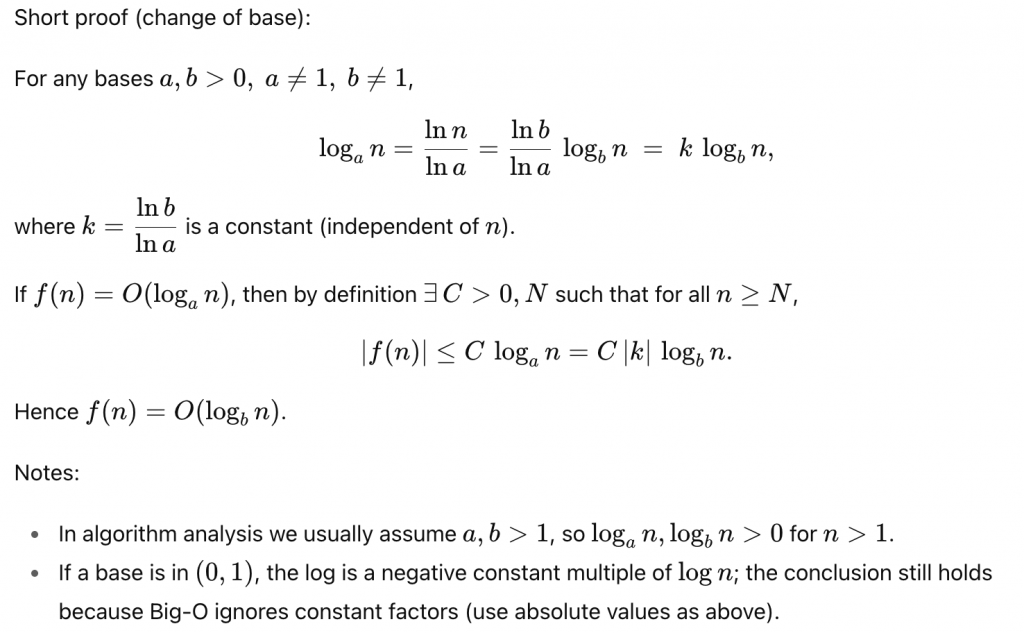
- log2021(n): This function grows very slowly compared to others. It’s a polynomial in log(n)\log(n)log(n), and the base of the logarithm is usually not specified in asymptotic analysis, but it doesn’t affect the growth rate significantly in this context.
- sqrt(n): This function grows faster than any logarithmic function but slower than linear or polynomial functions.
- nlog2(n) : This grows faster than sqrt(n) because it combines linear growth with a logarithmic factor. However, it grows slower than any polynomial function of nnn.
- n2: This is a polynomial function of nnn and grows faster than nlog2(n).
- sqrt(2n): This can be simplified to 2n/2, which grows exponentially but slower than n2 and nn
- n!: This factorial function grows faster than exponential functions like 2n. Factorials grow faster than any polynomial or exponential function for sufficiently large n.
- nn: This function grows the fastest among the given functions. It’s an exponential function with the base and exponent being n, which grows extraordinarily fast.