
James Skon, Chalmers 428, 740-427-5369
Department of Mathematics and Statistics
Room: Hayes 203
Office: Chalmer 428
Time: 2:30-4:00, Days: T,TH
Office hours:
Please sign up for an appointment here: Link
Walk-ins are welcome, but people with appointments are given priority.
- Tuesday & Thursday 8-9, 10-11, In person. Chalmers 428. Sign up
- Monday & Wednesday 9-11: May be virtual: Sign up
There are two ways of constructing a software design: One way is to make it so simple that there are obviously no deficiencies, and the other way is to make it so complicated that there are no obvious deficiencies. The first method is far more difficult.
C. A. R. Hoare (1980 Turing Award Lecture)
Course Overview.
This course provides an in-depth exploration of software development methodologies and practices. Students will engage in designing, implementing, testing, and maintaining software applications using contemporary programming languages and tools. Key topics include object-oriented programming, user interface design, full-stack development, version control with GitHub, data visualization, and automated testing. Through collaborative projects and hands-on assignments, learners will develop the skills necessary to build robust, user-friendly applications and effectively work within development teams. Prerequisites include introductory programming courses or equivalent experience. Prerequisite: SCMP 118 or permission of instructor.
Course Objectives
At the completion of this course the students should
- Exhibit best practices in creating code that is well structured and organized using object-oriented concepts.
- Exhibit an understanding of quality use of identifier naming within code.
- Be capable of providing appropriate internal documentation within code.
- Understand and utilize proper use of internal barricading and error checking of values within a program.
- Be capable of creating detailed requirement for a problem bending solved.
- Be capable of creating architectural designs for multi-component software systems.
- Be capable of collaboration in software development including pair-programming, peer design and code reviews.
- Create and set up virtual machince running Linux in the cloud (AWS)
- Learn Ruby and Ruby on Rails to develop Full Stack applications
- Be capable of creating and using a database using SQL and phpmysql.
- Write JavaScript code using HTML, CSS and jQuery.
- Be able to create an HTML and JavaScript front end that communicate with a C++ program through an Apache2 web server.
- Design and develop web based data visualization components and user interfaces that use quality metaphoric concepts.
Texts
- Code Complete, Second Edition; Steve McConnell. Microsoft Press; 2nd edition
- Full Stack Ruby on Rails
- Introduction to Programming with Ruby
- Object Oriented Programming with Ruby
- Introduction to the Command Line
- Introduction to HTTP
- Introduction to Programming with JavaScript
- Core Ruby Tools
- Introduction to SQL
- Ruby Challenges
Grading
Due Date: All assignments are due as specified in the grading table below.
Missing Lab Assignments: Labs are an important part of this class; the effort spent on them is a crucial part of the learning process. Failure to submit labs is unacceptable: students earning 0s on two labs cannot receive a grade higher than a B- for the course; students earning three 0s on labs will receive an automatic F for the course.
Collaboration and Academic Honesty: In order to facilitate learning, students are encouraged to discuss assignments amongst themselves. Copying a solution is not, however, the same as “discussing.” A good rule of thumb is the “cup of coffee” rule. After discussing a problem, you should not take away any written record or notes of the discussion. Go have a cup of coffee or cocoa, and read the front page of the newspaper. If you can still re-create the problem solution afterward from memory, then you have learned something, and are not simply copying. (The “group work” are exempt from this, as they are intended to be done together.)
| Category | % | Notes |
| Homework | 20% | Due by Midnight. 10% penalty for up top 24 hours late, then 50% off. |
| Quizzes | 15% | Must be taken in class. Cannot be taken later without a note from either the provost office or the dean of students (Professor Hawks). |
| Individual Projects | 45% | Due by midnight on day due. 5% penalty for for up to 12 hours late. One assignment may be up to 24 hours late with no penalty with instructor notification. Projects have intermediate milestones and final complete project. Each milestones are typically worth 10-20 points, while the final grade is 100 points. |
| Team Project | 20% | Similar grading as above. All members are typically given the same grade unless there is evidence of certain team mambers. |
| TOTAL | 100% |
Class server
This class will use a server at: http://3.134.78.249/.
Change Database root password:
ALTER USER ‘root’@’localhost’ IDENTIFIED BY ‘KenyonToday!’;
Technical Topics
- Using the Linux Server
- RESTful Microservices
- JavaScript, HTML and CSS
- Bootstrap
- SQL
- Ruby
- Ruby on Rails
- Node.js
- git and GitHub
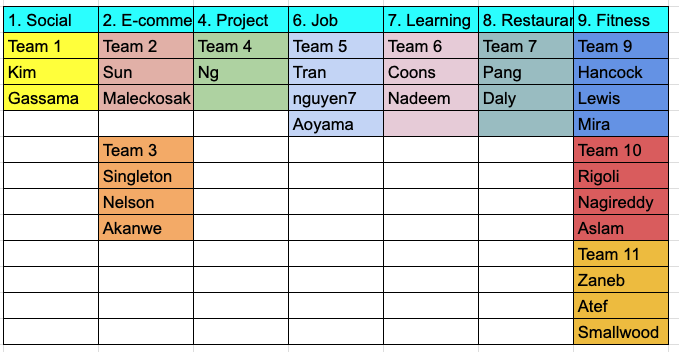
Lab 3 teams:
Schedule
Project Grading Rubric
| Criteria | Excellent | Acceptable | Unacceptable |
|---|---|---|---|
| Documented & Maintainable (The program is well-documented with appropriate names and comments making it easy to understand.) |
|
|
|
| Adaptable & Reusable (The program is modular, using abstraction well and any limitations are clearly specified.) |
|
|
|
| Robust & Correct (The program provides the correct output for all possible input.) |
|
|
|
| Efficient & Elegant (The program uses both time and space on the computer effectively, without losing source code clarity.) |
|
|
|
| 25-20% | 19-11% | 10-0% |
Team Demo Rubric
| Requirement | Comments | Points | Score |
| Meets Functional Expectations | 40 | ||
| Presentation Organization | 30 | ||
| Preparation – Team is prepared with examples | 30 | ||
| Total | 100 |
Tools
- Visual Studio Code
- HTML Validator
- cygwin – This is a tool to give you Linux software on a Windows system. A good way to get SSH.
- NetBeans
- Linux
- in on from Mac
- Using Notepad++ to edit and transfer files on Windows
- Using TextWrangler to edit and transfer files on Mac
- html & css
- Introduction to HTML
- Introduction to SQL Course
- Information on XMLHttpRequest Object
- AJAX introduction
- AJAX programming hints and suggestions
- Tips for using GitHub and git
- POSIX Threads Programming
- XML Parser for C++, Documentation
- 7 JavaScript Things I Wish I Knew Much Earlier In My Career
- Data Visualization with D3 course
- Using Node.js To Create Real-Time Web Applications
- Socket.io: let’s go to real time!
- Socket: emit Cheat Sheet, Serving multiple file types.
- Fifo’s in python
- to guide for developing software
Schedule
Non Discrimination Statement
Kenyon College does not discriminate in its educational programs and activities on the basis of race, color, national origin, ancestry, sex, gender, gender identity, gender expression, sexual orientation, disability, age, religion, medical condition, veteran status, marital status, genetic information, or any other characteristic protected by institutional policy or state, local, or federal law. The requirement of non-discrimination in educational programs and activities extends to employment and admission.
All employees, including faculty, are considered Responsible Employees and must notify the College’s Civil Rights & Title IX Coordinator with any relevant information.
For further information, please refer to the following Kenyon College policies:
Sexual Misconduct & Harassment: Title IX, VAWA, Title VII:
Pythonps://www.kenyon.edu/directories/offices-services/ocr/title-ix-vawa/kenyon-policies/title-ix-policy/
Discrimination & Discriminatory Harassment Policy (non sex or gender):
Pythonps://www.kenyon.edu/directories/offices-services/ocr/discrimination/
ADA & Section 504:
Pythonps://www.kenyon.edu/directories/offices-services/ocr/discrimination/504-ada-grievance/student-grievance-procedure-resolving-complaints-under-ada-section-504/
Disabilities
If you have any disability and therefore may have need for some type of accommodation in order to participate fully in this class, please feel free to discuss your concerns in private with Erin Salva, director of Student Accessibility and Support Services (SASS). (phone: (740) 427-5453).
Statement on Title IX
Kenyon College does not discriminate in its educational programs and activities on the basis of race, color, national origin, ancestry, sex, gender, gender identity, gender expression, sexual orientation, disability, age, religion, medical condition, veteran status, marital status, genetic information, or any other characteristic protected by institutional policy or state, local, or federal law. The requirement of non-discrimination in educational programs and activities extends to employment and admission.
All employees, including faculty, are considered Responsible Employees and must notify the College’s Civil Rights & Title IX Coordinator with any relevant information.
For further information, please refer to the following Kenyon College policies:
Sexual Misconduct & Harassment: Title IX, VAWA, Title VII:
https://www.kenyon.edu/directories/offices-services/ocr/title-ix-vawa/kenyon-policies/title-ix-policy/
Discrimination & Discriminatory Harassment Policy (non sex or gender):
https://www.kenyon.edu/directories/offices-services/ocr/discrimination/
ADA & Section 504:
https://www.kenyon.edu/directories/offices-services/ocr/discrimination/504-ada-grievance/student-grievance-procedure-resolving-complaints-under-ada-section-504/